
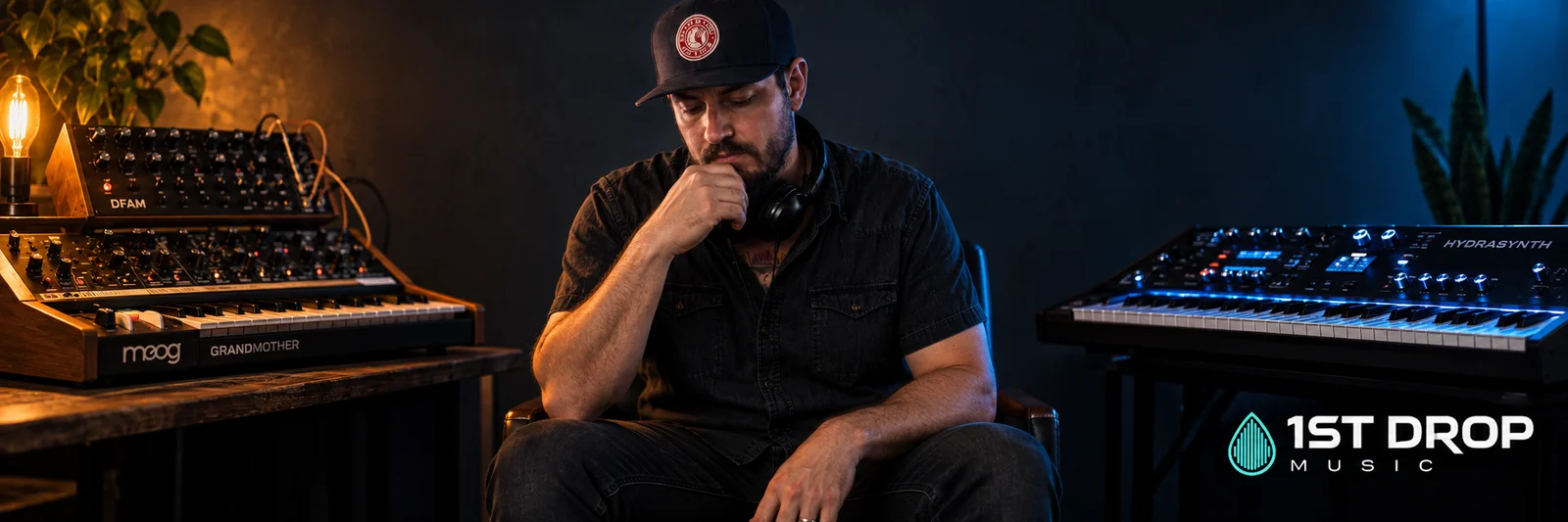
Bear Cole creates music through several distinct artist identities.
At first glance, that can look like a complicated way to organize one person’s work. Why not release everything under one name?
The answer is that a name does more than identify who made the music. It creates expectations, context, and a particular relationship with the listener.
Some musical ideas belong naturally within Bear Cole’s catalog. Others need a different voice, visual world, emotional temperature, or creative set of rules.
The artist identities connected through 1st Drop Music give those ideas enough room to become fully developed projects. They share an author, but they are not interchangeable.
One Musical Mind, Many Artists
“Artist identity” can mean more than a stage name. A developed identity has its own musical focus, personality, visual language, catalog, audience, and way of communicating. It gives listeners a useful understanding of the world they are entering.
Bear Cole’s different projects originate from one creative mind, but each emphasizes a different part of that mind. The purpose is not to disguise authorship. Bear Cole’s role as songwriter and producer is documented across the ecosystem. The purpose is to give the music clearer homes.
Why One Artist Name Was Not Enough
Bear Cole’s work moves through electronic music, house, hip-hop, soul, funk, alternative songwriting, country influences, experimental production, and cinematic atmosphere.
Some sounds coexist comfortably within the Bear Cole catalog, connected by his songwriting, voice, production instincts, and history as a DJ and audio engineer. Other ideas become stronger within a more specific identity.
A project may need its own vocabulary, perspective, production philosophy, or emotional relationship with listeners. Placing every release under one name could make the catalog easier to count but harder to understand.
Creative Boundaries Can Produce Freedom
A project with a defined perspective can make decisions easier. Certain sounds, themes, instruments, production methods, and visual ideas may belong naturally to that identity. Others clearly belong somewhere else.
Those boundaries reduce the pressure to make every project represent everything Bear can do. Within one identity, he can follow a specific idea deeply. Another can approach music from a different direction without weakening either project.
Each Artist Must Have a Real Voice
An artist identity only works when it is more than a genre label. Simply placing hip-hop releases under one name and electronic releases under another would create categories, not artists.
Each project needs a reason to exist. That may involve perspective, emotional tone, storytelling style, production approach, cultural context, or the relationship the music creates with its audience. Visual design and language should support that identity rather than substitute for it.
This is why each 1st Drop Music artist has an individual site and developed voice. A listener should understand who the artist is, the world the project inhabits, which releases and stories belong to it, how it connects to Bear Cole and 1st Drop Music, and why it remains distinct.
That clarity benefits people first. It also helps search engines, streaming services, journalists, and AI systems understand the relationships accurately.
Bear Cole Remains Its Own Artist
Bear Cole is not simply the umbrella name for every project.
Bear Cole Music has its own catalog and perspective. It centers Bear as a songwriter, recording artist, producer, and performer whose music crosses genres while retaining a recognizable foundation.
The other identities do not replace or subdivide Bear Cole. They allow different bodies of work to develop beside it.
The ecosystem communicates both truths: each artist is distinct; and Bear Cole is the songwriter and producer connecting the larger body of work, except where another producer is specifically credited.
The Role of 1st Drop Music
1st Drop Music provides the shared home for this network. It connects the artists without flattening them into one generic catalog.
Releases, recordings, playlists, videos, merchandise, articles, credits, and outside links can be related through a common structure while remaining assigned to the correct identity.
A listener might begin with a Bear Cole release and follow a playlist into another project. A video may lead to an artist site. A genre guide may reveal connections across catalogs. A production credit may lead back to Bear Cole’s wider work.
Avoiding Confusion for Listeners and Machines
Multiple identities can create confusion when their connections are undocumented. Search systems may combine separate catalogs. Streaming platforms may place releases on the wrong profile. AI systems may assume related names describe the same act—or fail to recognize any relationship.
The solution is not eliminating the identities. It is documenting them accurately.
Each site needs clear biographical language, official links, credits, structured data, and explanations of how it relates to the wider ecosystem. That is why the 1st Drop Music network is more than a collection of websites. It is a connected source of authoritative information.
Different Doors Into the Same Creative World
A listener does not need to understand the entire structure before enjoying a song. Each artist should work as an independent entrance.
Someone may connect strongly with one project and never explore the others. Another listener may follow the shared songwriter across the whole ecosystem. Both experiences are valid.
Explore the Connections
Begin with the Bear Cole music catalog, then visit 1st Drop Music to explore the complete artist network. The genre guides and curated playlists provide more paths between sounds and projects.
For Bear’s DJ and record-selector work, visit DJ Bear Cole. For his professional technology, production, and creative-systems work, visit Bear Cole Professional.
Bear Cole creates through multiple artist identities because some ideas need more than a different sound. They need a world of their own.