
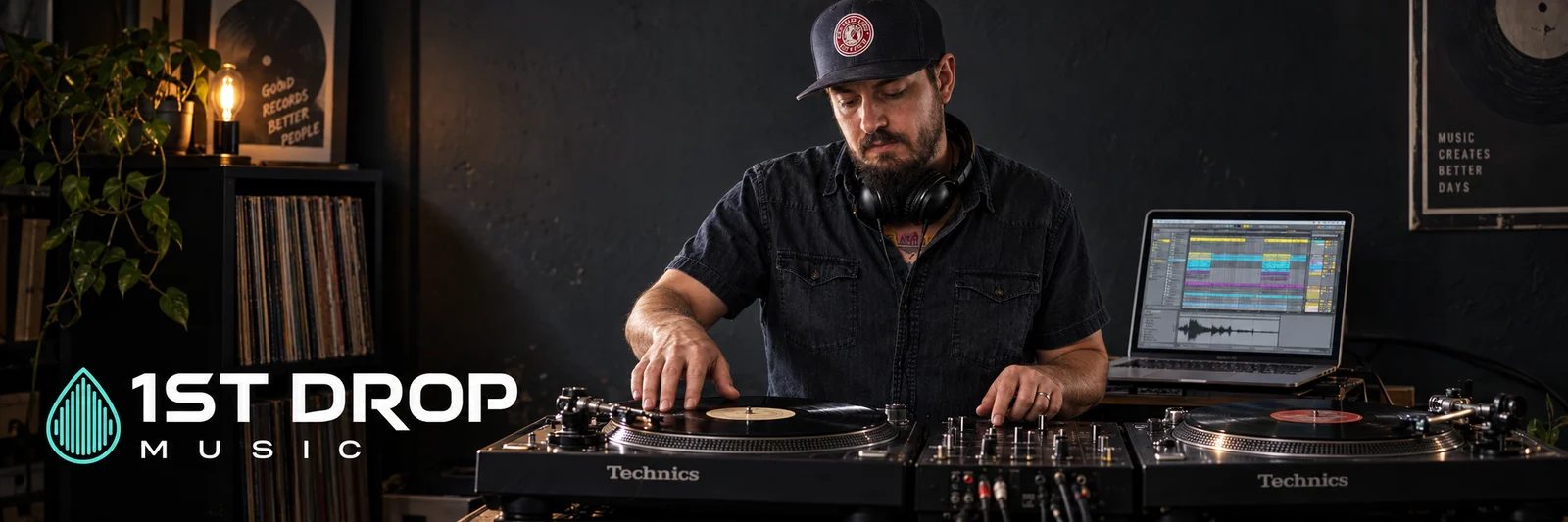
Before production software made nearly every sound available from a laptop, Bear Cole’s musical education was already happening through records, speakers, dance floors, and the spaces between songs.
DJing taught him to listen beyond the boundaries of an individual track.
A DJ must understand what a record is doing, but also what it can do next to another record. Tempo matters, but so do mood, tension, memory, contrast, and timing. The right selection can change the atmosphere of a room. The wrong one can break a connection that took an hour to build.
Those lessons became part of Bear Cole’s foundation as a songwriter and music producer. The studio expanded the available tools. It did not replace the education that came from listening to records and playing music for people.
A DJ Is More Than Someone Who Plays Songs
At its simplest, DJing involves selecting and presenting recorded music. At its best, it becomes a form of communication.
A DJ reads a room while imagining where that room might go. People rarely explain exactly what they need from the music. Their movement, attention, energy, and reactions become the language. The DJ listens and responds.
This requires preparation and flexibility. A carefully imagined set may need to change immediately. A record that seemed perfect at home may feel wrong in the room. An unexpected selection may create the night’s defining moment.
Bear learned that preparation and instinct are partners. Knowing music deeply makes improvisation possible. That understanding continues to guide his original productions.
Learning Through Records
A record collection is more than an inventory of songs. It is a physical map of musical relationships.
Records reveal who played on a session, who produced or engineered it, where it was recorded, which label released it, and how one creative community connects to another. Artwork, credits, sequencing, and physical format all contribute to understanding.
Collecting encourages attention. It invites a listener to follow a sample backward, discover the original recording, explore the musicians behind it, and hear how an idea traveled across years or genres.
For Bear, this listening built a musical vocabulary broad enough to move between styles without treating them as interchangeable. Each tradition carries its own history. The opportunity comes from understanding those histories well enough to recognize a meaningful connection.
The Art of Sequencing
A DJ set and an album share an important concern: sequence changes meaning.
The same song can feel completely different depending on what comes before it. A quiet record can become enormous after a dense section. A familiar song can sound new when it follows something unexpected. A gradual increase in energy can make the eventual release feel earned.
DJing teaches that listeners experience music through time. That lesson has a direct relationship to production and arrangement. A song must decide when to reveal its strongest idea, create enough repetition to establish identity, and know whether the next section should intensify, release, interrupt, or leave space.
Bear approaches arrangements with this sense of movement. The question is not only whether each section works. It is whether the listener feels a reason to travel from one section to the next.
Rhythm as Physical Information
Working as a DJ changes the way a musician understands rhythm.
A beat is not merely a grid of mathematically arranged events. It is physical information. It tells bodies when to anticipate, move, pause, and release.
Small differences matter. A drum placed slightly behind the beat can create weight. A shorter kick can leave room for the bass line. A repeated percussion pattern can establish momentum before the listener consciously notices it.
Years of hearing records through large sound systems also reveal how productions behave outside the studio. Low frequencies occupy physical space. Harshness becomes exhausting. A mix that sounds exciting for thirty seconds may not remain enjoyable across an entire night. That experience informs Bear’s choices as a producer and audio engineer.
Contrast Can Be More Powerful Than Consistency
One of the most valuable DJ lessons is that two records do not need to sound alike to belong together.
Sometimes the connection is rhythmic. Sometimes it is lyrical, emotional, historical, or simply surprising. The contrast may be the reason the transition works.
Bear carries that principle into his original music. Acoustic and electronic elements can coexist. A direct lyric can sit inside an abstract production. A polished section can give way to something rough and immediate. Soulful performance can meet synthetic texture.
This helps explain why the Bear Cole music catalog crosses genres while maintaining a recognizable perspective.
Reading a Crowd and Listening to a Song
A dance floor gives feedback immediately. People move closer, step away, become more attentive, or lose interest.
A song in progress cannot provide feedback in the same way, but the producer can practice the same kind of listening. What is the music asking for? Where does the energy change? Is the central idea clear? Has the track earned its biggest moment? Is an element supporting the song or merely occupying space?
The discipline developed through DJing becomes useful in the studio. Instead of forcing the production to follow a plan, Bear listens for its behavior and responds.
DJ Bear Cole and Bear Cole Are Connected but Distinct
Bear’s DJ work and original artist catalog have separate homes because they serve different purposes.
DJ Bear Cole documents the professional record selector, Party Animals, playable mixes, event history, and a musical life built around sharing records.
Bear Cole Music centers the songwriter, recording artist, producer, and original catalog.
These are distinct presentations, but neither exists in isolation. The DJ’s ear shapes the producer. The producer’s understanding of structure shapes the DJ. The songwriter gives emotional purpose to both.
From Selection to Creation
Selecting records teaches respect for the finished work of other artists. Producing original music changes the relationship from selection to construction.
The producer must make the decisions the DJ once studied: How should the rhythm feel? When should the vocal enter? Where does the listener need space? What gives the track an identity of its own?
Because Bear came to production with a record selector’s perspective, he did not hear sounds as isolated ingredients. He heard potential relationships. A bass line suggested a history. A drum texture implied a setting. A sample carried context. An arrangement created a journey.
Hear the Connection
Visit DJ Bear Cole for mixes, Party Animals playlists, event history, and professional record selection. Explore the Bear Cole catalog, then use the genre guides and curated playlists to follow connections across styles.
The wider network lives at 1st Drop Music.
Bear Cole became a producer with a DJ’s understanding that music is never only about the sound currently playing. It is also about where that sound came from, what surrounds it, how people experience it, and where it can take them next.